Evidence Line
Note
This data class is at a trial use maturity level and may change in future releases. Maturity levels are described in the maturity-model.
Computational Definition
An independent, evidence-based argument that may support or refute the validity of a specific Proposition. The strength and direction of this argument is based on an interpretation of one or more pieces of information as evidence for or against the target Proposition.
Information Model
Some EvidenceLine attributes are inherited from Information Entity.
Field |
Flags |
Type |
Limits |
Description |
|---|---|---|---|---|
id |
string |
0..1 |
The ‘logical’ identifier of the Entity in the system of record, e.g. a UUID. This ‘id’ is unique within a given system, but may or may not be globally unique outside the system. It is used within a system to reference an object from another. |
|
name |
string |
0..1 |
A primary name for the entity. |
|
description |
string |
0..1 |
A free-text description of the Entity. |
|
aliases |
⋮ | string |
0..m |
Alternative name(s) for the Entity. |
extensions |
⋮ | 0..m |
A list of extensions to the Entity, that allow for capture of information not directly supported by elements defined in the model. |
|
specifiedBy |
0..1 |
A specification that describes all or part of the process that led to creation of the Information Entity |
||
contributions |
↓ | 0..m |
Specific actions taken by an Agent toward the creation, modification, validation, or deprecation of an Information Entity. |
|
reportedIn |
⋮ | 0..m |
A document in which the the Information Entity is reported. |
|
type |
string |
1..1 |
MUST be “EvidenceLine”. |
|
targetProposition |
0..1 |
The possible fact against which evidence items contained in an Evidence Line were collectively evaluated, in determining the overall strength and direction of support they provide. For example, in an ACMG Guideline-based assessment of variant pathogenicity, the support provided by distinct lines of evidence are assessed against a target proposition that the variant is pathogenic for a specific disease. |
||
hasEvidenceItems |
⋮ | 0..m |
An individual piece of information that was evaluated as evidence in building the argument represented by an Evidence Line. |
|
directionOfEvidenceProvided |
string |
1..1 |
The direction of support that the Evidence Line is determined to provide toward its target Proposition (supports, disputes, neutral) |
|
strengthOfEvidenceProvided |
0..1 |
The strength of support that an Evidence Line is determined to provide for or against its target Proposition, evaluated relative to the direction indicated by the directionOfEvidenceProvided value. |
||
scoreOfEvidenceProvided |
number |
0..1 |
A quantitative score indicating the strength of support that an Evidence Line is determined to provide for or against its target Proposition, evaluated relative to the direction indicated by the directionOfEvidenceProvided value. |
|
evidenceOutcome |
0..1 |
A term summarizing the overall outcome of the evidence assessment represented by the Evidence Line, in terms of the direction and strength of support it provides for or against the target Proposition. |
DATA STRUCTURE
In VA-Spec, the Evidence Line class and its profiles can support the general data structure below.
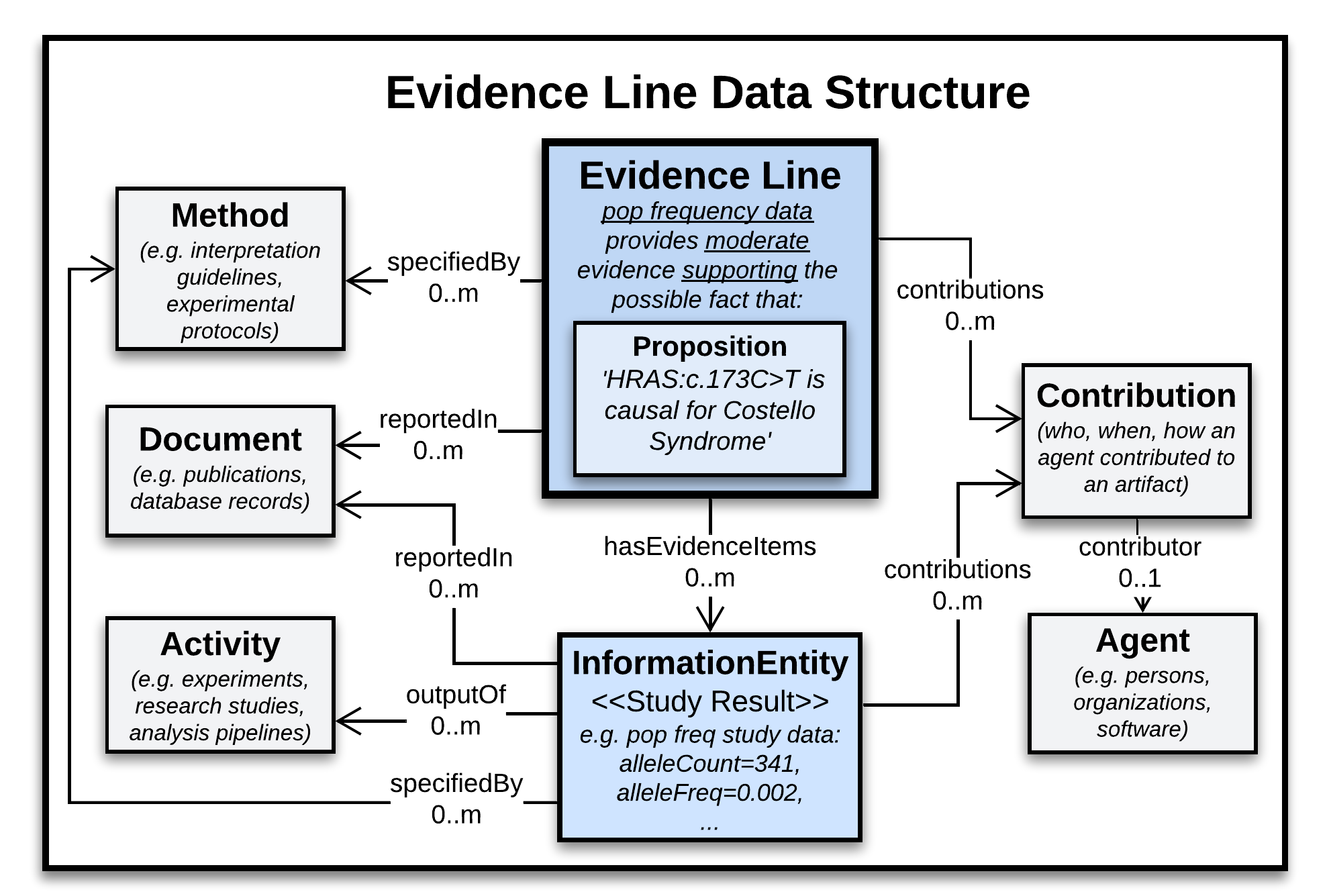
Evidence Line Data Structure
Legend A class-level view of the Evidence Line-based structures supported in VA-Spec data. Italicized text in each class exemplify the kind of information each may capture - here for an Evidence Line representing a moderate argument supporting the pathogenicity of a particular variant, based on allele frequency data from gnomAD.
In this structure:
An Evidence Line roots a central axis where it is linked zero or more pieces of information (e.g. Study Results) that were used to build the argument it represents.
The Proposition contained in the Evidence Line object encapsulates a structured representation of the possible fact toward which evidence is interpreted and scored (e.g. that ‘HRAS:c.173C>T is causal for Costello Syndrome’ - for which gnomAD data is assessed to provide moderate support).
Note that this target proposition can be omitted if an Evidence Line is attached to a Statement with the same proposition (as in the previous Statement diagram) - but otherwise should be provided.
As with Statements, classes surrounding this central axis are used to describe the provenance of the Evidence Lines and its Evidence Items.
A data example illustrating this structure for Evidence Lines supporting a Variant Pathogenicity Statement can be found here.
IMPLEMENTATION GUIDANCE
1. Attaching Evidence to Statements
The SEPIO-VA model can represent the fact that a piece of information (e.g. a Data Set, Study Result, or prior Statement) was used as evidence for or against a new Statement in one of two ways, depending on how much detail is provided/desired:
If the source data includes details about how the information was interpreted and applied as evidence (e.g. the direction and strength it provides for or against the target Statement, and provenance information about how this was assessed) - an
EvidenceLineobject is created to capture this detail (see below for more).For simpler data that merely reports that some piece of information was used as evidence supporting a Statement, a
hasEvidencerelation can be used to link the Statement directly to objects representing the information used as evidence (without the need to create an interveningEvidenceLine).
2. Meaning and Utility of Evidence Lines
Evidence Lines are used to capture one or more pieces of information (i.e. evidence items) that are assessed together as an argument for or against some target proposition - and report the direction (supports or disputes) and strength (e.g. strong, moderate, weak) that the argument is determined to make.
For example, the allele count and frequency calculations for the BRCA2 c.8023A>G variant in the gnomAD database are evidence items that may be collectively assessed to build an EvidenceLine making argument of moderate strength that supports a target proposition that the variant is pathogenic for Breast Cancer.
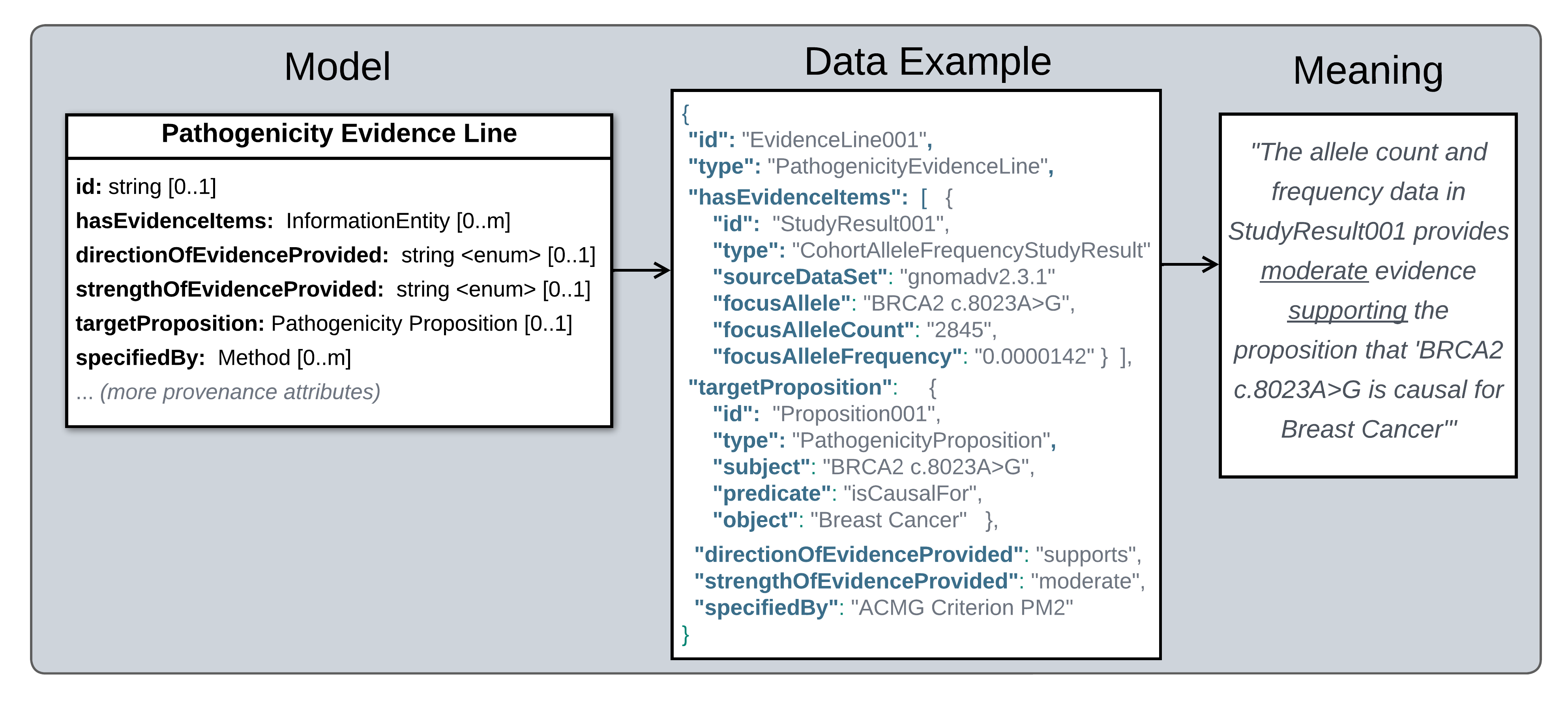
In an EvidenceLine instance, the
targetPropositionattribute reports the ‘possible fact’ that the evidence is assessed against. TheevidenceItemsattribute captures the information assessed as evidence. And thedirectionOfEvidenceProvidedandstrengthOfEvidenceProvidedattributes report the outcome of this assessment - whether the evidence line supports or disputes the target proposition, and how strongly. Additional attributes allow provenance information about the evidence assessment process to be captured (who did it, when, using what guidelines, etc).
3. Evidence Line Scope
Evidence Lines are flexible with respect to the granularity of arguments they support, and the scope of evidence items they can collectively assess.
Narrow scoping will bucket available evidence into many, fine-grained Evidence Lines that make the most atomic independently meaningful arguments possible. The ACMG Variant Pathogenicity Interpretation Guidelines are an example of a fairly fine-grained evidence interpretation framework.
Broader scoping approaches may organize the same available evidence into fewer Evidence Lines that build and assess less atomic arguments based on a wider and more diverse set of evidence items. For example, CIViC curators assess the strength and direction of evidence items at the level of all information reported in a publication for a specific study - which can encompass many different results and evidence types that under more fine-grained interpretation approaches might be split apart and assessed as separate lines of evidence.
This CIViC EID5682 record (https://civicdb.org/evidence/5682/summary) is a clear example of this. We see here that CIViC evidence assessments are performed at the level of all results reported in PMID:23143947 - which would captured as a single Evidence Line that assigns a strength (level C) and direction (supports) to the collective argument made by this evidence. However, as detailed in the free-text summary of this EID, the more fine-grained ACMG framework breaks out and separately assess two arguments here - one based on criterion PP1 (disease co-segregation evidence), and one based on criterion PP4 (highly specific gene-phenotype information) - which a finer-grained representation would capture as two distinct Evidence Lines.
This example illustrates the flexible scope of Evidence Lines to fit different curation processes- where ACMG-based curation might assess evidence at a finer-grained level that would support a larger number of more atomic Evidence Lines, while CIViC curators might assess the same evidence all together in a single, more broadly-scoped Evidence Line - in virtue of its being reported in the same publication.