Data Structures
Below we describe the data structures that can be built around three key classes in the VA Core Model: Statement, Study Result, and Evidence Line.
These classes represent the kinds of artifacts provided by most community databases and interpretation platforms.
Accordingly, they are the basis of VA Profiles provided by the VA-Spec, which are used by implementations to structure and exchange variant knowledge.
Statement Structure
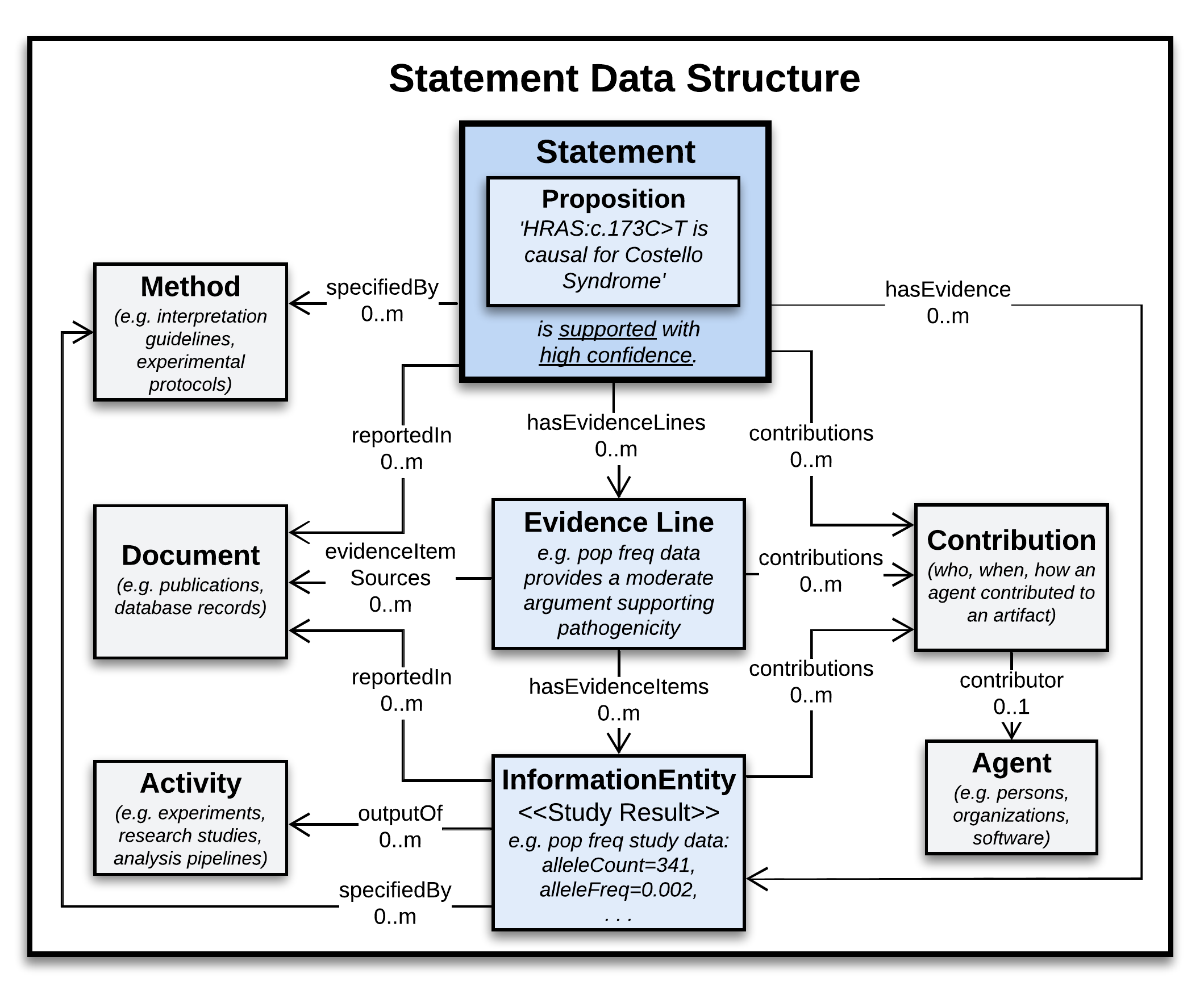
Statements represent assertions or assessments of general knowledge about a variant - e.g. an assertion that HRAS:c.173C>T is pathogenic for Costello Syndrome, or an assessment that there is presently only moderate evidence supporting this possible fact. In VA-Spec, a Statement roots the larger data structure below.
Statement Data Structure
Legend A class-level view of the Statement-based structures supported in VA-Spec data. Italicized text in each class exemplify the kind of information each may capture, here in the case of a Variant Pathogenicity Statement supported by Population Allele Frequency evidence.
In this structure:
A Statement roots a central axis where it is linked to zero or more Evidence Lines representing discrete arguments for or against it.
Each Evidence Line may be linked to zero or more Evidence Items - which can be any information used to build its evidence-based argument (here, a single Study Result).
The Proposition contained in the Statement object encapsulates a structured representation of the possible fact that the Statement may assert or assess (e.g. that ‘HRAS:c.173C>T is causal for Costello Syndrome’). Unless otherwise stated, this is the same proposition against which evidence is assessed in any supporting Evidence Lines.
Surrounding this central axis are classes that describe the provenance of the central artifacts, including Contributions made to them by Agents, Activities performed in doing so, Methods that specify their creation, and Documents that describe them.
A data example illustrating this structure for a Variant Pathogenicity Statement can be found here.
More on the internal semantics of Statement objects can be found in the Statement Class page. And more on Propositions in the next section.
Evidence Line Structure
Evidence Lines represent assessments of how a specific set of evidence items is interpreted to build an argument for or against some possible fact (their “target proposition”), which may ultimately be asserted as true or false in a Statement.
These assessments report the strength and direction of such an argument. For example, an Evidence Line may report a set of gnomAD allele frequency data about HRAS:c.173C>T to provide moderate evidence supporting a proposition that it causes Costello Syndrome.
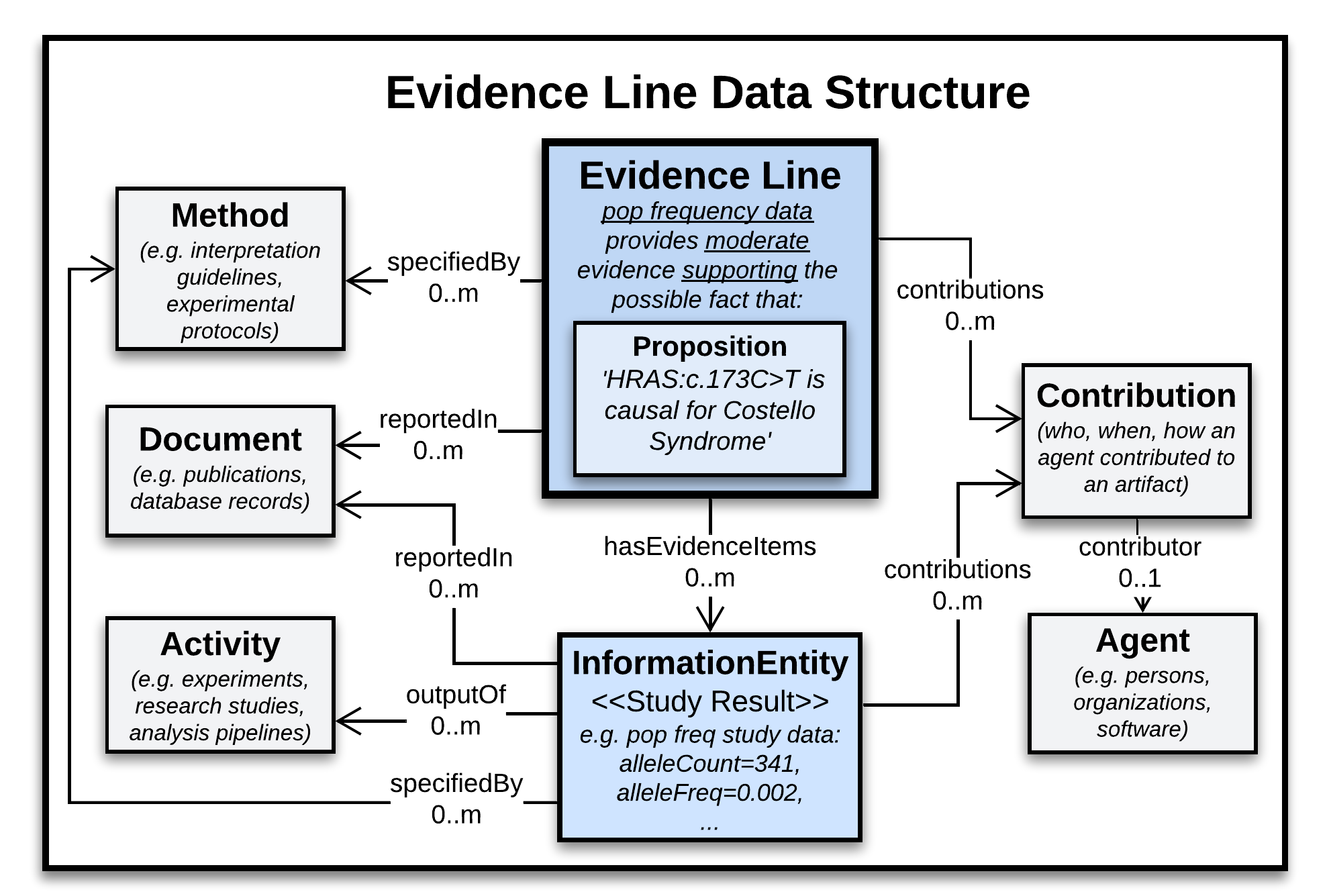
As seen in the Statement diagram above, Evidence Lines may be linked to a Statement for which they represent a supporting or disputing argument. However some organizations ‘pre-curate’ such arguments in the absence of a definitive Statement they support, so that these Evidence Lines can be retrieved and collectively assessed once sufficient evidence exists to make a definitive assertion about their shared target proposition. In this context, an Evidence Line roots the general data structure below.
Evidence Line Data Structure
Legend A class-level view of the Evidence Line-based structures supported in VA-Spec data. Italicized text in each class exemplify the kind of information each may capture - here for an Evidence Line representing a moderate argument supporting the pathogenicity of a particular variant, based on allele frequency data from gnomAD.
In this structure:
An Evidence Line roots a central axis where it is linked zero or more Evidence Items that were used to build the argument it represents (here, a single Study Result).
The Proposition contained in the Evidence Line object encapsulates a structured representation of the possible fact toward which evidence is interpreted and scored - here, the possible fact that ‘HRAS:c.173C>T is causal for Costello Syndrome’ - for which gnomAD data is assessed to provide moderate support).
Note that this target proposition can be omitted if an Evidence Line is attached to a Statement with the same proposition (as in the Statement diagram above) - but otherwise should be provided.
As with Statements, classes surrounding this central axis are used to describe the provenance of the Evidence Lines and its Evidence Items.
A data example illustrating this structure for Evidence Lines supporting a Variant Pathogenicity Statement can be found here.
More on the internal semantics of Evidence Line objects can be found in the Evidence Line Class page. More on Propositions in the next section.
Study Result Structure
Study Results represent defined collections of more foundational data items about a specific variant that result from a particular study or analysis - e.g. cohort allele frequency calculations and scores about HRAS:c.173C>T in different populations from the gnomAD dataset. Curators often assess such collections of related data items as evidence during the process of interpreting a particular variant - which may result in a higher order Statement about it (e.g. a pathogenicity classification).
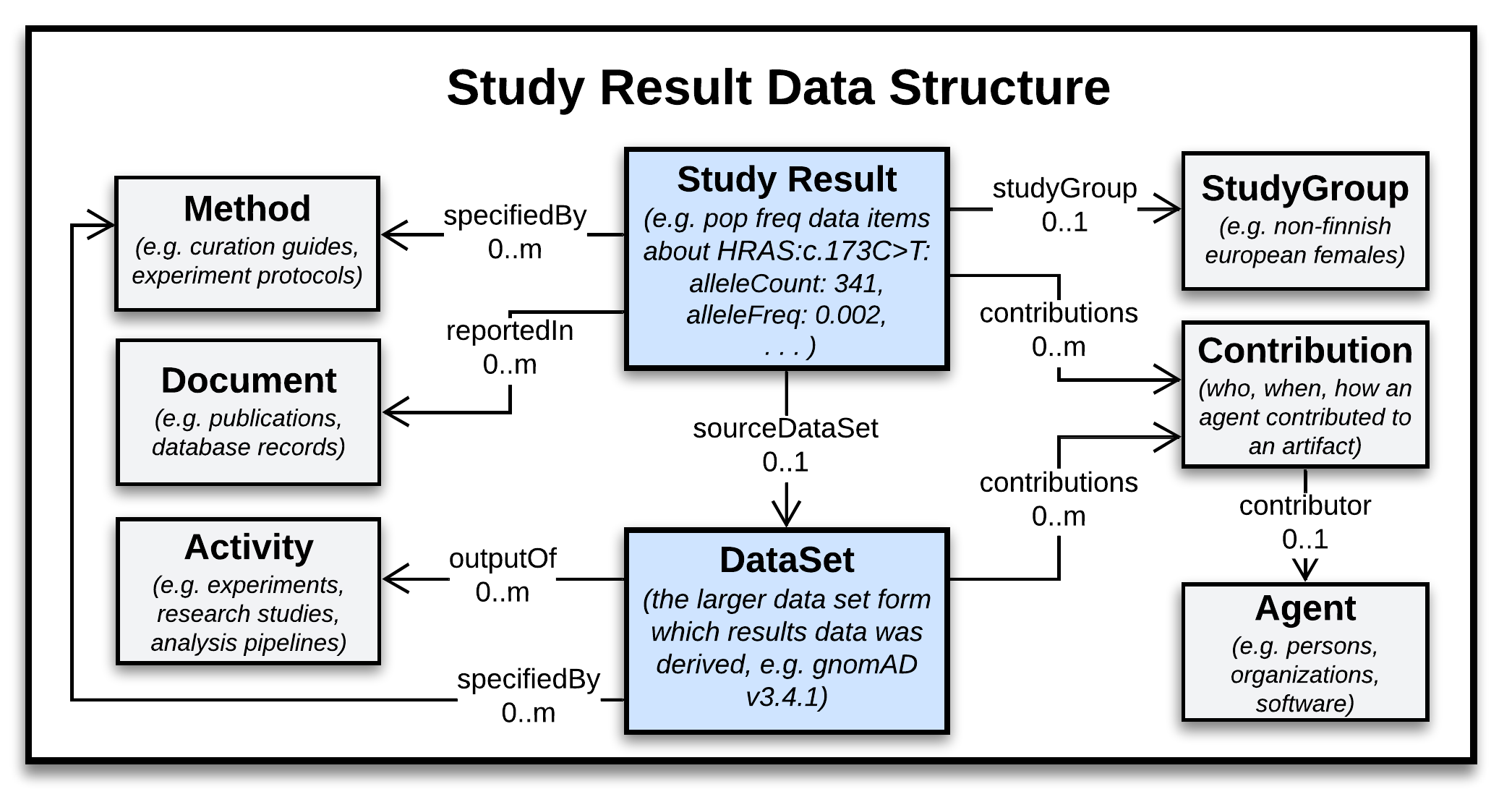
As seen in the previous diagrams, Study Results may be linked to Evidence Lines or directly to Statements they support. However, some organizations ‘pre-curate’ and store Study Results as stand-alone artifacts, which can subsequently be retrieved and assessed as evidence for higher order Statements they may support. In this context, a Study Result roots the general data structure below.
Study Result Data Structure
Legend A class-level view of the Study Result-based structures supported in VA-Spec data. Italicized text in each class exemplify the kind of information each may capture - here in the case of a Cohort Allele Frequency Study Result reporting data from the gnomAD dataset about a particular variant.
In this structure:
A Study Result and the data items it holds can be linked to the larger Data Set from which they came, and a description of the Study Group from which the data was collected.
Note that no Proposition object is used here, because Study Results represent more foundational data, and do not assert or assess evidence for possible facts about the domain.
As with Statements and Evidence Lines, classes surrounding a Study Result can be used to describe the provenance of the data it contains.
A data example illustrating this structure for a Study Result interpreted as evidence for a Variant Pathogenicity Statement can be found here.
More on the internal semantics of Study Result objects can be found in the Study Result Class page.