Role of Propositions
Propositions represent possible facts about the domain of discourse that may be true or false. They are abstract entities that capture a ‘sharable’ piece of meaning whose identity is independent of space and time, and which make no claim as to whether the sentiment it expresses is true or not.
As illustrated in the Data Structures section, the job of a Proposition object is to encapsulate a structured representation of a possible fact so it can be referenced and reused across Statements and Evidence Lines.
Propositions in Statements
In a Statement, a given Proposition may be asserted to be true or false, or assessed to report the strength of existing evidence supporting it (e.g. “there is presently moderate evidence supporting the proposition that ‘HRAS:c.173C>T causes Costello Syndrome’”).
An example of a Proposition as an assessed possible fact is illustrated below.
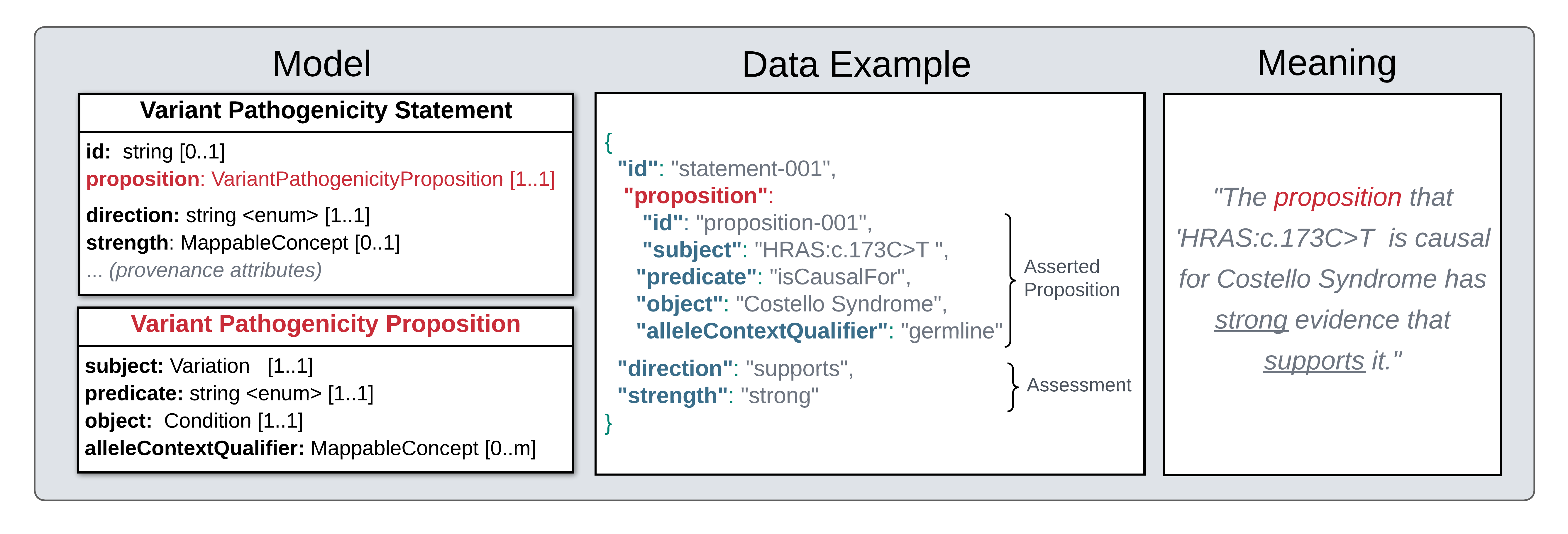
Role of Propositions in Statements
Legend: Left panel. Abridged version of the Variant Pathogenicity Statement model. Center Panel. An example of a Variant Pathogenicity Statement object (note use of shorthand syntax to capture values that should be wrapped in MappableConcepts). Right Panel. Plain language meaning of what structured data in the example reports to be true. Use of propositions in each panel is highlighted in red text.
Propositions in Evidence Lines
In an Evidence Line, a given Proposition captures the possible fact toward which Evidence Items are assessed and scored (e.g. that gnomAD population frequency evidence items are evaluated toward proposition that “HRAS:c.173C>T causes Costello Syndrome” when assessing the evidence as providing moderate support). An example of a Proposition* in this role is illustrated below.
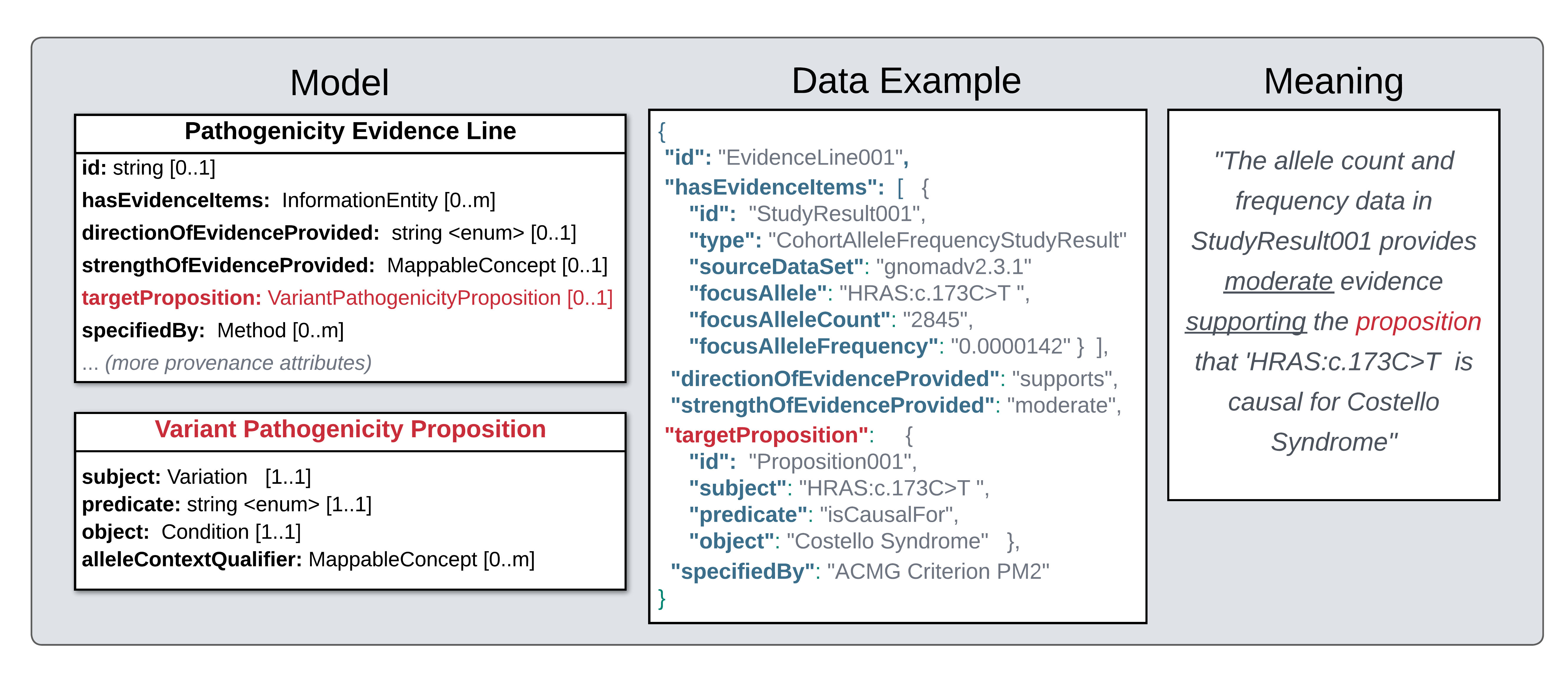
Role of Propositions in Evidence Lines
Legend: Left panel. Abridged version of a Pathogenicity Evidence Line model. Center Panel: An example of a Pathogenicity Evidence Line object (note use of shorthand syntax to capture values that should be wrapped in MappableConcepts). Right Panel: Plain language meaning of what structured data in the example reports to be true. Use of propositions in each panel is highlighted in red text.
In VA-Spec data, Propositions are used only in the context of a Statement or Evidence Line, as they convey no knowledge in the absence of the assessments these objects provide.
While Propositions are required in Statements, they are optional in Evidence Lines - and can be omitted if the Evidence Line is attached to a Statement with the same Proposition. For example, in the data example here the root Statement asserts the same Proposition (Proposition001) toward which its two Evidence Lines evaluate the support provided by population frequency and functional impact data. This Proposition object is explicitly referenced in the Evidence Lines in the example, but omission of this reference is permissible, and would imply that the target Proposition here is the same as that in the root Statement.
For more information, see the Proposition page, and related Design Decision.